FIRE (Financial Independence, Retire Early) and traditional retirement both aim for a stage of life when you do not have to work for money. The main differences are when you get there, how much you save along the way, and how you use your wealth. This article compares both paths: what each assumes, why the numbers differ, and how to decide which approach, or blend, fits you.
FIRE vs Traditional in Brief
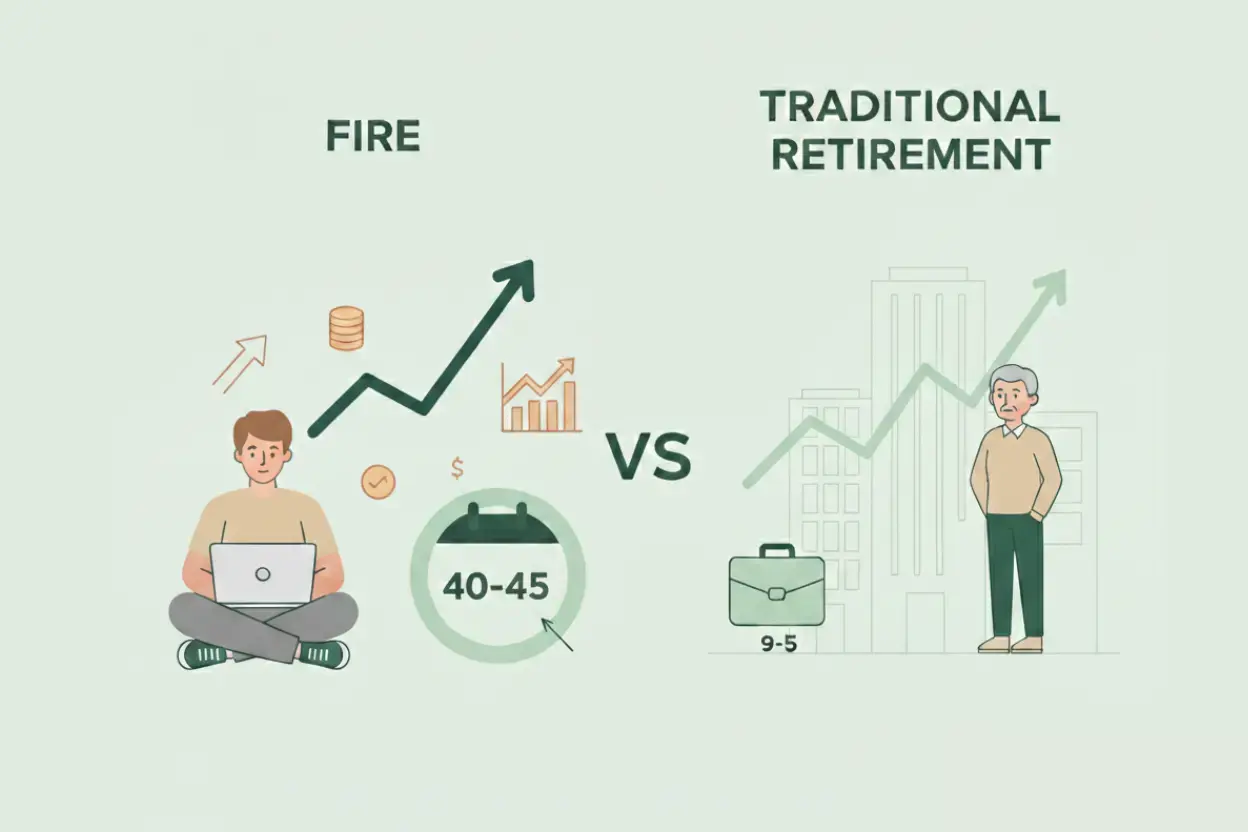
FIRE targets financial independence and optional retirement much earlier than the typical age 60 to 65. Traditional retirement usually assumes a long career and often relies on employer pensions or social security. Both require saving and investing; FIRE typically demands a higher savings rate and earlier discipline so you can live off investments sooner.
Differences at a Glance
- FIRE: reach financial independence early (often 30s to 50s) and live off investments.
- Traditional retirement: work until 60-65, then rely on pension, social security, and savings.
- FIRE usually requires a higher savings rate and a clear target (e.g. 25× expenses).
- Both benefit from compounding; the difference is timing and how aggressively you save.
What Is Traditional Retirement?
Traditional retirement is the familiar model: work for several decades, save in employer plans or personal accounts, and retire around 60-65. Income in retirement often comes from a mix of pensions, social security or similar benefits, and drawdowns from savings. The timeline is long and the savings rate is often moderate; the system is built around a full career.
Retirement planning in this mould assumes you have contributed for 30-40 years. The replacement ratio, how much of your pre-retirement income you get in retirement, is designed for someone who saved gradually. If you save 10-15% of income over a full career, plus any employer match, you may reach a similar outcome by 65. The key is time: traditional retirement leans on decades of compounding and consistent saving.
What Is FIRE?
FIRE is the goal of becoming financially independent early, often in your 30s, 40s, or 50s, so you can choose whether to work. You save and invest aggressively, aim for a target like 25× annual expenses, and plan to live off your portfolio using a sustainable withdrawal rate. There is no single right age; it is whenever your investments can cover your expenses.
Variants exist: lean FIRE (minimal expenses, smaller corpus), fat FIRE (higher lifestyle, larger corpus), and barista or coast FIRE (enough invested that a lower-stress job or part-time work covers expenses). The common thread is front-loading saving and investing so that passive income or withdrawals can replace the need to work full-time well before 60.
Main Differences
- Timing: FIRE targets independence much earlier than 60-65.
- Savings rate: FIRE often requires 50%+ of income saved; traditional retirement may be 10-20%.
- Income sources: FIRE relies heavily on personal investments; traditional may include pension and state benefits.
- Mindset: FIRE emphasizes cutting unnecessary spending and investing the gap; traditional retirement often assumes gradual saving over a long career.
Why the Difference Matters
If you want to retire early, you cannot rely on a 40-year career to slowly build a nest egg. You need to compress saving into fewer years, which means a higher savings rate and a clear target. Compounding still helps, but starting early and saving more each month accelerates the timeline. Passive income from investments is what makes FIRE possible; dividends and interest eventually cover your expenses.
Numerical example: two people earn the same and spend the same. One saves 15% for 40 years; the other saves 50% for 15 years. The second reaches a given corpus sooner because they put away more each year and still benefit from 15 years of growth. The trade-off is lifestyle during those 15 years: lower spending and higher saving. FIRE is that trade-off made explicitly.
When Each Path Makes Sense
Traditional retirement fits if you are comfortable working into your 60s, have access to a pension or strong social security, and prefer a moderate savings rate without big lifestyle cuts. FIRE fits if you want the option to stop full-time work earlier and are willing to save a large share of income for a defined period. Many people blend both: they save more than the typical 10-15% but do not aim for extreme frugality, landing somewhere between a classic retirement age and early 40s.
The Role of a Clear Target
FIRE depends on knowing your number: how much you need so that a sustainable withdrawal (e.g. 3-4% per year) covers your expenses. Without that target, early retirement is a vague wish. A step-by-step FIRE number calculation turns it into a plan. Traditional retirement can also benefit from a number, but the longer timeline and often pension or state benefits allow more room for gradual adjustment.
Long-Term Sustainability
Both paths require a plan that lasts. Traditional retirement can fail if someone saves too little or withdraws too much; FIRE can fail if the withdrawal rate is too high for a 40-year horizon or if expenses rise unexpectedly. Sustainability comes from a realistic expense estimate, a conservative withdrawal rate, and flexibility to cut spending or earn in down years. Neither path is set and forget; both benefit from periodic review.
Common Mistakes
- Assuming FIRE and traditional retirement need the same savings rate; FIRE usually needs more.
- Ignoring healthcare and inflation when planning for a long early retirement.
- Thinking FIRE means no work ever; many pursue side projects or part-time work by choice.
- Comparing yourself to others; your number and timeline depend on your expenses and goals.
Takeaways
- FIRE and traditional retirement both aim for financial security; FIRE does it earlier with a higher savings rate.
- Traditional retirement often includes pension and state benefits; FIRE relies on personal investments.
- Choose or blend approaches based on your target age, lifestyle, and willingness to save aggressively.
Conclusion
FIRE and traditional retirement both aim for financial security; FIRE pushes the finish line earlier and demands more upfront saving and discipline. Neither is inherently better; it depends on your goals and lifestyle.
Disclaimer
The information in this article is for educational purposes only and does not constitute financial or investment advice. All figures and calculations are illustrative. Consult a qualified financial advisor before making any financial decisions.
Key Takeaways
- FIRE targets financial independence much earlier than typical retirement age.
- Traditional retirement often assumes a long career and pension or social security.
- Both require saving and investing; FIRE usually demands a higher savings rate and earlier discipline.
Ready to Calculate Your FIRE Number?
Use our free FIRE calculator to get your personalized financial independence roadmap and 24-month action plan.
Calculate Your FIRE Number Now